


How Self-Cleaning Litter Boxes Work: Rotating Drums, Timed Rakes, and the Sensors That Stop Them

A self-cleaning litter box separates clumps from clean litter with one of three mechanisms and decides when to run with a sensor or a timer. A rotating drum (Litter-Robot 4, Neakasa M1 Plus, PetSafe SmartSpin, PETKIT Purobot Max 3) turns the whole bed so a screen sifts clumps into a drawer; a rake box (PetSafe ScoopFree, Pet Zone Smart Scoop) drags a comb across a flat pan into a bin; a crystal-tray box (ScoopFree Crystal, PETKIT Crystal Duo) lets silica litter absorb urine and rakes only solids. What starts the cycle is a sensor that sees the cat leave, followed by a default countdown of 3 minutes on the SmartSpin up to 20 on the ScoopFree Crystal, and what stops it mid-turn is a second set of sensors the manuals describe in detail below. CPSC listed no recall for any of the eight boxes here as of 10/27/2026.
Rotating drums: how the sift works
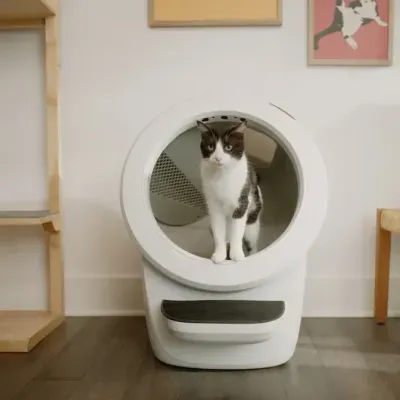
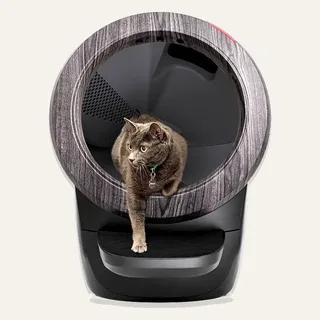
The drum is a sphere or cylinder with a screen inside. Litter sits in the bottom while the cat uses it; after the cat leaves and a delay passes, a motor rotates the drum so the litter passes over the screen, clumps that cannot fall through are carried up and tipped into a drawer below, and the drum rotates back, leveling the clean litter. Whisker's manual gives the Litter-Robot 4 a default cycle delay of 7 minutes, extendable "up to 30 minutes"; Neakasa's manual says "The M1 will automatic clean 5 minutes after your cat leaves" (p. 11); PetSafe's SmartSpin starts a 3-minute default countdown and rotates its sphere "180° and back" (guide). The drawer is the consumable: Whisker says "as low as once every 8 days" between emptyings for one cat, Neakasa "every 7 to 10 days", PetSafe "about once a week".
What varies between drums is the opening. The Litter-Robot 4 and SmartSpin are hooded spheres; the Neakasa M1 Plus is an open-top drum the cat steps over; PETKIT's Purobot Max 3 is a cylinder whose "gear is intentionally incomplete. That means a permanent opening, no matter what. Even with no power and no sensors, your cat can always back out" (PETKIT product page). All of them need a clumping litter that forms clumps the screen can catch: Whisker, Neakasa, and PETKIT each list the litters that will not work, from newspaper and wood pellets to loose-clumping and lightweight types.
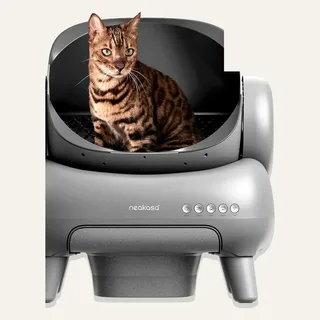
Neakasa M1 Plus Open Top Self-Cleaning Cat Litter Box
Open-top · No subscription · first year $404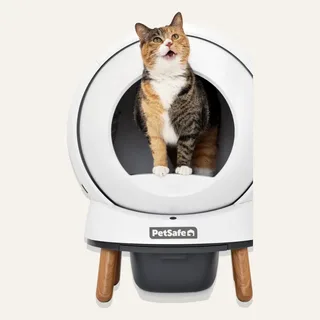
ScoopFree SmartSpin Self-Cleaning Litter Box
Rotating globe · No subscription · first year $431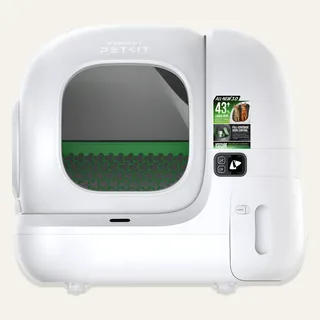
Purobot Max 3 Automatic Cat Litter Box
Rotating globe · No subscription · first year $488Rakes: the countdown instead of the turn
A rake box keeps the litter flat. Sensors or a timer wait after a visit, then a motorized comb travels the length of the pan, pushes clumps and solids into a covered waste compartment at the end, and returns. PetSafe's ScoopFree Crystal Plus guide describes the sequence: "Sensors inside the litter box recognize when your cat is present. When your cat leaves the litter box, the rake button will blink blue and the rake timer will start a 20-minute countdown." The timer stops if the cat comes back and resets when it leaves. The Pet Zone Smart Scoop has a cat sensor too, of a type its manual does not name: the unit "features a sensor that detects when your cat is in the box" (p. 3), "will automatically complete a cleaning cycle 15 minutes after your cat leaves the box", and shows a green blinking light when it "has detected a cat and is waiting 15 minutes", while its Amazon listing says 30 minutes, a disagreement between the maker's own documents. The listing calls it "Semi Automatic" without saying why.
Crystal trays: absorbing instead of clumping
The ScoopFree crystal boxes and PETKIT's Purobot Crystal Duo use a disposable tray of silica crystals instead of clumping litter. PetSafe's FAQ says the crystal "absorbs urine and dehydrates solid waste"; the rake moves only the dried solids into the covered trap, and the tray is thrown away whole. PetSafe's chart gives a tray 20 to 30 days for one cat, 10 to 15 for two, and 7 to 10 for three or more; PETKIT's page says a tray keeps the area clean "for up to 30 days" and, in a footnote, that it "lasts up to 45 days", with no cat count. The trade is the consumable bill: ScoopFree trays are $44.99 for 2 and PETKIT's are $79.99 for 4 at the makers' stores on 10/09/2026, and both makers say ordinary clay litter cannot be used. PETKIT's manual (p. 26) is explicit: "Do not use crystal cat litter or litter trays from other brands or types".
What starts a cycle and what stops it
Three kinds of sensor appear in the manuals, and each of the four drums here combines weight sensors with a second kind that watches the opening or the cat's movement.
- Weight sensors. The Litter-Robot 4 has "Weight Sensors located in the base" and stops the globe "if additional weight is detected during a cycle", resuming "after 15 seconds of the additional weight exiting" (manual, p. 21); the same sensors identify which cat visited. Neakasa lists "4 weight sensors" in the M1 Plus; PetSafe's SmartSpin lights its cat-entry indicator at "a weight change of more than 2.5 pounds" (guide, p. 14).
- Infrared and laser sensors. The Litter-Robot 4 adds "Curtain Sensors looking downward across the unit opening", a Class 1 laser product "in accordance with IEC 60825-1:2014" (manual, p. 39); Neakasa says the M1 Plus has "6 pairs of swiping infrared sensors"; PETKIT says the Max 3's "12 sensors track movement and weight in real time. If your cat steps in mid-cycle, the cylinder stops immediately"; the SmartSpin and the ScoopFree OpenSky show display code 1 when the infrared sensor is blocked (guides).
- Timers and clutches. The Pet Zone Smart Scoop runs a 15-minute timer once its unnamed sensor sees the cat leave, and stops on resistance: "Red, solid: Unit has encountered excessive resistance" (manual, p. 9). The Crystal Duo stops its rake when a cat enters, by PETKIT's description of "Four detection sensors".
The boxes also tell you why they stopped: the SmartSpin's numbered display codes, Neakasa's red and yellow indicators for a weight-sensor overload, a blocked motor, or a cat interrupting the cycle (manual, p. 15), and, on the discontinued Litter-Robot 3, a yellow flash when the bonnet is off (manual, p. 20).
Minimum cat weight, by the manuals
The weight sensor sets a floor, and every maker here prints a weight or age floor. Litter-Robot 4: at least 1.36 kg, which the product page prints as 3 lb, and "We do not recommend that kittens or cats that weigh less than 1.36 kg use the Litter-Robot in the unattended Automatic Mode" (p. 34). Neakasa M1 Plus: 2.2 lb, and below that "set the device to Kitten Mode. Clean under supervision using the control buttons" (p. 4). PETKIT Purobot Max 3: "Strictly prohibited for cats weighing less than 1.5 kg" (3.3 lb) and "for use by kittens under 6 months of age" (p. 27). PETKIT Crystal Duo: the same 3.3 lb and 6 months (p. 26). PetSafe SmartSpin: unplug or turn off auto-clean until the kitten "is at least 2.5 pounds (1.1 kg) and 6 months old" (guide). PetSafe ScoopFree Crystal: unplug "until she is at least 6 months old" (guide 400-2625). Pet Zone Smart Scoop: 6 to 15 lb by its Amazon listing (the title says sixteen) and "Not intended for kittens under 6 months of age" (manual, p. 4). The Litter-Robot 4, Neakasa, and PETKIT boxes have a kitten or manual mode and the SmartSpin an auto-clean switch that disables automatic cycling for exactly this case; for the ScoopFree Crystal, PetSafe's answer is to leave it unplugged.
Recalls and what the makers say about kittens
CPSC's recall database returned 0 results for Whisker, Litter-Robot, Neakasa, PETKIT, PetSafe ScoopFree, and Pet Zone litter boxes when we searched on 10/09/2026, 10/14/2026, and again on 10/27/2026; the only PetSafe and Pet Zone recalls on record are a 2010 heated-bed power adapter and 2025 laser-pointer toys. We found no CPSC action on any self-cleaning litter box. What the makers do say is in the previous section: a floor weight, a kitten age, and a mode that turns the motor off until the cat meets both.
The boxes themselves, with first-year cost, drawer days, and owner complaints, are ranked on best automatic litter boxes; the sensor systems are described model by model in the Litter-Robot 4 review and the PetSafe brand review. The method is on how we research.
Questions people ask
How does a self-cleaning litter box know when the cat has left?
With a weight sensor, an infrared sensor, or both. The Litter-Robot 4 uses weight sensors in the base plus downward-looking laser curtain sensors (manual, p. 21); the Neakasa M1 Plus lists six pairs of infrared sensors and four weight sensors; PetSafe's ScoopFree Crystal uses sensors that start a 20-minute countdown when the cat leaves. The Pet Zone Smart Scoop has a sensor of a type its manual does not name and waits 15 minutes after the cat leaves. Models by sensor type are compared on best automatic litter boxes.
What is inside a Litter-Robot?
A globe with a screen, weight sensors in the base, curtain sensors across the opening, and a waste drawer below. After a cat leaves and a 7-minute default delay passes, the globe rotates so clumps are sifted through the screen into the drawer, then rotates back; if weight is added mid-cycle the globe stops and resumes 15 seconds after it leaves (manual, p. 21). The full teardown by section is in the Litter-Robot 4 review.
Is a self-cleaning litter box safe for cats?
None of the boxes here has a CPSC recall: the recall database returned 0 results for Whisker, Litter-Robot, Neakasa, PETKIT, PetSafe ScoopFree, and Pet Zone on 10/09/2026, 10/14/2026, and 10/27/2026. The manuals rest safety on stopping the motor when a cat is inside: the Litter-Robot 4 halts the globe "if additional weight is detected during a cycle" and watches the opening with curtain sensors (manual, p. 21), and PETKIT says the Max 3's cylinder "stops immediately" if a cat steps in mid-cycle. Each maker also prints a weight or age floor, with a kitten or manual mode for cats below it. These are the makers' own descriptions; the recall search is the only outside check on this page.
Can a kitten use a self-cleaning litter box?
Every manual we read says no below a weight or age floor: 3 lb (1.36 kg) for the Litter-Robot 4, 2.2 lb for the Neakasa M1 Plus, 3.3 lb and 6 months for PETKIT's boxes, 2.5 lb and 6 months for the SmartSpin, 6 months for the ScoopFree Crystal, 6 months for the Pet Zone (its Amazon listing adds 6 lb). The makers' answer for a smaller cat is a kitten or manual mode that stops automatic cycling, or, for the ScoopFree Crystal, unplugging it. PetSafe's kitten modes are described in the PetSafe brand review.
What is the difference between a semi-automatic and an automatic litter box?
There is no single rule; makers use the label loosely. An automatic box waits for the cat to leave, by weight or infrared, and stops if the cat comes back mid-cycle. The Pet Zone Smart Scoop, sold as "Semi Automatic", has a cat sensor too, but its manual lists resistance, not the sensor, as what stops the rake mid-cycle (p. 4); other semi-automatic boxes have no motor at all and sift when you roll them.